

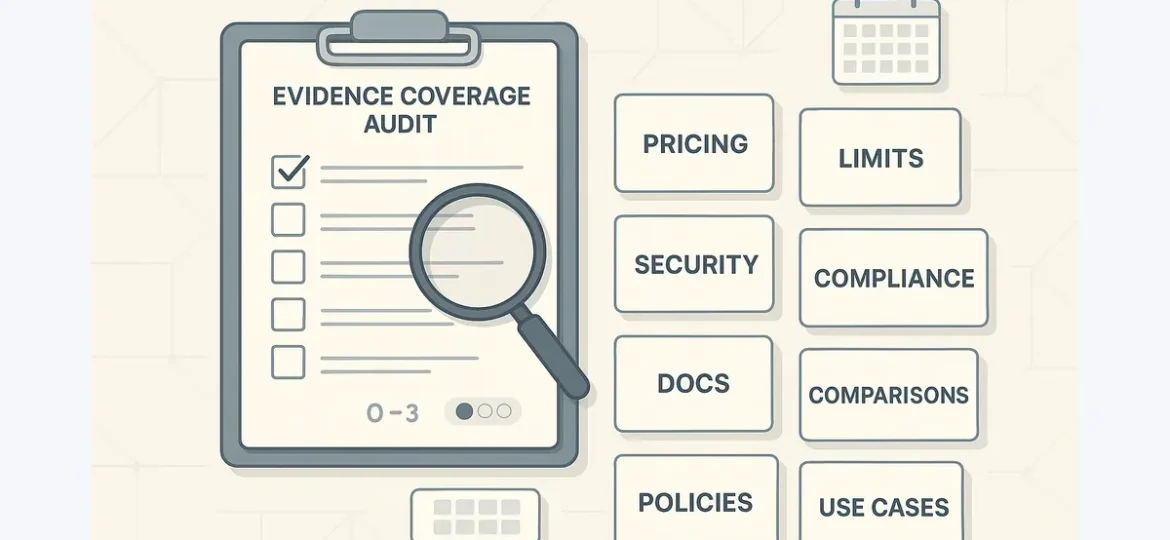
If an AI system (Google AI Overviews, Bing, Perplexity, chat-based assistants) can’t retrieve proof for your pricing, limits, policies, and outcomes, it will hedge—or skip recommending you. Evidence coverage fixes that: publish verifiable answers buyers look for, in one place, in a format machines can pull.
Evidence coverage: what it is and why AI recommendations depend on it
Evidence coverage = the breadth and quality of retrievable proof that answers evaluation questions (pricing, limits, security, implementation, outcomes). It’s not persuasive copy. It’s whether important statements are backed by specific, scannable, linkable evidence.
- Claims: marketing statements a reader can’t verify.
- Evidence: specific, scoped details (with boundaries and dates when time-sensitive).
Micro-example (claim vs evidence):
- Claim: “Fast setup.”
- Evidence: “Typical setup takes 30–60 minutes; requires admin access + SSO configured; onboarding checklist linked; last updated May 2026.”
How recommendations form (high level): these systems synthesize answers from what they can retrieve—public product pages, docs/help centers, trust/legal pages, and other crawlable sources. Missing, contradictory, or scattered proof lowers confidence.
By the end, you’ll be able to run a proof-point audit, score gaps, and turn findings into a prioritized fix backlog.
This complements E-E-A-T: authority matters, but recommendations often fail on missing proof artifacts.
Checklist: required intent evidence (audit these first)
Treat each bullet as an answerable evaluation question. For every item, capture the single best URL that contains the proof (or mark “missing”).
1) Offer definition evidence
- What does the product do (one sentence) and the core job-to-be-done?
- Who is it for (role, company type, environment)?
- Who it’s not for (constraints, non-supported use cases, deal-breakers).
- Deployment model (SaaS, self-hosted, hybrid) + key prerequisites.
2) Pricing & packaging evidence
- Current tiers/packages and what’s included in each.
- Billing terms: monthly/annual, renewals, minimums (if any).
- Trial basics: length, what’s included, what happens after.
- Refund/cancellation basics (high level).
If you use “contact sales” pricing, still publish packaging boundaries:
- What’s in Standard vs Enterprise (capabilities, support/SLA class, security/compliance options).
- What drives price (seats, usage, workspaces, API calls, volume), even without numbers.
3) Specs & limits evidence
- Feature boundaries: what’s supported vs not supported.
- Compatibility: integrations, browsers, OS, SDKs, dependencies.
- Usage/performance limits: quotas, rate limits, file size, concurrency, fair use.
- Availability/regions: where the service operates; data residency options.
4) Policies & trust evidence (no legal deep dive)
- Security and privacy overview (concrete practices, not “we take security seriously”).
- Data handling: retention/deletion basics; training/usage of customer data (if applicable).
- Compliance signals: SOC 2/ISO, GDPR/DPAs, HIPAA (only if true).
- Support basics: hours/channels; SLA targets or a pointer to the SLA page.
Verification cue: for security/compliance statements, link to the authoritative artifact (trust center, attestation letter process, policy page) and keep scope tight (what’s covered, for which product, as of what date).
5) Implementation proof
- Prerequisites: access needed, systems involved, roles required.
- Setup overview: what happens first/next, with links to full docs.
- Typical timeline ranges and what changes them.
- Links to: docs/help center, API reference, onboarding checklist, sample configs.
How to run an evidence coverage audit (simple scoring rubric)
Step 1: Map evaluation questions to evidence types
Start with the required-intent checklist above, then add 5–10 questions pulled from:
- sales call notes (pricing objections, procurement questions)
- support tickets (limits, compatibility, “can it…?”)
- competitor bake-offs (migration, tradeoffs, proof points)
Step 2: Inventory your current sources
Pull URLs from places an LLM can usually retrieve:
- marketing site (product, solutions, integrations)
- pricing page(s)
- docs / help center
- trust center / legal pages (privacy, DPA, security)
- status page (if relevant)
Keep it to one row per evidence item, not one row per page.
Step 3: Score each evidence item on 5 criteria
Score Yes/No (or 0/1):
- Present: exists on a public, indexable URL.
- Specific: includes inclusions/exclusions, numbers, prerequisites, scoped statements.
- Current: has a visible date or clear maintenance signals.
- Accessible: crawlable text; not gated; not image-only/PDF-only.
- Consistent: doesn’t conflict with other official pages/collateral.
Micro-example (scoring):
- Pricing page is present (yes) but not specific (no—no inclusions), current (unknown—no date), accessible (yes), consistent (no—contradicts sales deck) ⇒ thin + inconsistent.
Evidence Coverage Audit Scorecard (1-page rubric)
| Evidence item | URL | Present | Specific | Current | Accessible | Consistent | Notes | Priority |
|---|---|---|---|---|---|---|---|---|
| Pricing inclusions per tier | ||||||||
| API rate limits | ||||||||
| Data retention & deletion |
Step 4: Categorize findings
Use one label per row:
- Missing: no authoritative URL exists.
- Thin: exists but vague (no boundaries, numbers, prerequisites, date).
- Fragmented/duplicated: split across near-duplicate URLs or contradicts itself.
Step 5: Prioritize by impact (and effort)
- Fix required intent items first (they block shortlisting).
- Then add supporting proof that addresses the biggest buying objections.
- Within each bucket: quick wins (add specifics/date, consolidate two pages) vs heavy lifts (new trust center, benchmark methodology, major docs restructuring).
Optional: involve marketing (publishing), product (truth/limits), support (implementation reality), legal/security (policy accuracy).
Publish evidence so AI can retrieve it reliably
An evidence audit only matters if the proof becomes findable, scannable, and canonical.
Page structure
- Use H2/H3s that match evaluation intents (“Pricing & tiers,” “Limits,” “Security & data handling,” “Implementation timeline”).
- Put a short above-the-fold summary with key proof points.
- Use tables for dense specs/limits (quotas, regions, compatibility).
Metadata and on-page cues
- Titles/descriptions should say what the page proves (pricing, limits, compliance scope, migration).
- Add a short “Key details” block near the top with a handful of facts (trial length, data retention window, SLA class).
Consolidation and canonicals
- Avoid splitting the same proof points across near-duplicate pages.
- Pick one authoritative URL per proof area and link to it everywhere else.
- Use canonical tags to prevent duplicates from competing.
Use Canonical Checker to spot split evidence and canonical conflicts.
Structured data (practical only)
Use schema where it makes proof points easier to parse:
- Organization: company details, support contacts, social profiles.
- Product: product description, offers (where applicable), key attributes.
- FAQPage: concise Q&A for pricing, limits, data handling, implementation.
- HowTo: onboarding/setup overviews (when steps are stable and public).
To make proof points obvious in snippets, use Meta Tags Generator.
Maintenance
- Assign an owner per proof area (pricing, limits, security, implementation).
- Set a review cadence (monthly for pricing/packaging; quarterly for limits/docs; quarterly/semiannual for policies).
- Add visible “Last updated” for time-sensitive evidence (pricing, benchmarks, retention, SLA/policies).
Accessibility note: don’t trap critical evidence in images or PDFs only. Publish proof points as crawlable text; link PDFs as supporting artifacts.
Deliverable: your 30-day evidence coverage plan
Start with one flagship offer first, then scale.
- Week 1: Create/repair required-intent pages (pricing/packaging, specs/limits, trust/policies, implementation overview). Add boundaries and link to authoritative security/compliance sources.
- Week 2: Consolidate and remove retrieval blockers. Merge duplicates; choose one authoritative URL per proof area. Fix canonicals, navigation paths, broken links. Add public summaries for gated content (and link to request access).
- Week 3: Add supporting evidence where it reduces objections (comparisons, use cases, customer proof based on top buying objections).
- Week 4: Implement schema/metadata + set maintenance cadence. Apply appropriate schema, tighten titles/descriptions, assign owners and review dates, add visible “last updated.”
Use Schema Generator to ship baseline Product/Organization/FAQ/HowTo markup without slowing the sprint.
Measure progress by outputs you control: improved rubric scores and fewer missing / thin / fragmented items.
Checklist: supporting evidence (only what improves confidence and differentiation)
Add these after required intent evidence is solid.
- Use cases with outcomes (scenario + metric/outcome + prerequisites)
- Example: “Reduce onboarding time from 2 weeks to 3 days for Sales Ops teams using Okta SSO + Salesforce integration.”
- Customer proof (case studies/reviews/logos with dates and specifics): what changed, for whom, under what constraints.
- Comparisons (vs alternatives/competitors): state tradeoffs; include migration basics (what imports, what doesn’t, typical timeline).
- Claim substantiation (for strong performance claims): benchmarks with methodology, scope, environment, and last updated. Replace unverifiable superlatives with scoped claims.
Your deliverable is a prioritized evidence backlog: required intent proof points first, then supporting proof, then structure/maintenance. Run the scorecard across your top 1–3 revenue-driving offers and fix the top 5 missing/thin items first.
Further reading: Google Search documentation.
